
The “Black Baron” of Kilravock was so named due to his dark skin and hair. Hugh Rose, the baron, was portrayed as a long-serving and unusually steady landowner who held his estate for 54 years during one of Scotland’s most turbulent periods.
In 1523 Hugh was in contract marriage to Katharine Falconer, daughter of Sir Alexander Falconer of Halkerton but it is believed as they were young this was not consummated till 1537. They had one son and 8 daughters.
At 40, Hugh fought at the Battle of Pinkie Cleugh, which was part of “The Rough Wooing”, near Musselburgh. This was the last pitched battle between Scotland and England before the Union of the Crowns, it was a catastrophic bloody defeat for Scotland. He was captured and ransomed, he was lucky to survive. Probably after seeing much bloodshed, it reshaped his character for the rest of his life and he became a peaceful man.
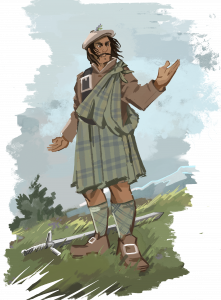
Hugh Rose, the Black Baron. Illustrated by Emilie Schieve
Kilravock was appointed Sheriff-Principal of Inverness on September 22th, 1565. He was confirmed as constable of the castle of Inverness during this period. He lived through the continuous political and religious upheaval, including the Regency of Mary de Guise, the Scottish Reformation, the dramatic life and downfall of Mary, Queen of Scots, as well as the violent fates of several regents and finally the reign of James VI. Despite this instability both nationally and in the Highlands, he remained peaceful and focused on managing his lands, building his estate, and maintaining good relations with neighbours in particular with the Gordons of Huntly and the Earls of Moray.
The Catholic Gordons of Huntly often clashed with the Protestant Earls of Moray. A key event was Huntly’s defeat at the Battle of Corrichie in 1562. This feud reflected the wider instability of the Highlands, where clan politics and religious divisions frequently led to violence.
Remarkably, he maintained correspondence and trust with leaders from all opposing factions without clearly aligning himself with any side. No records reveal his personal political or religious loyalties, yet all parties seemed to respect and rely on him. His defining trait was neutrality and stability amid chaos, allowing him to prosper and avoid the conflicts that engulfed others during the 16th Century.
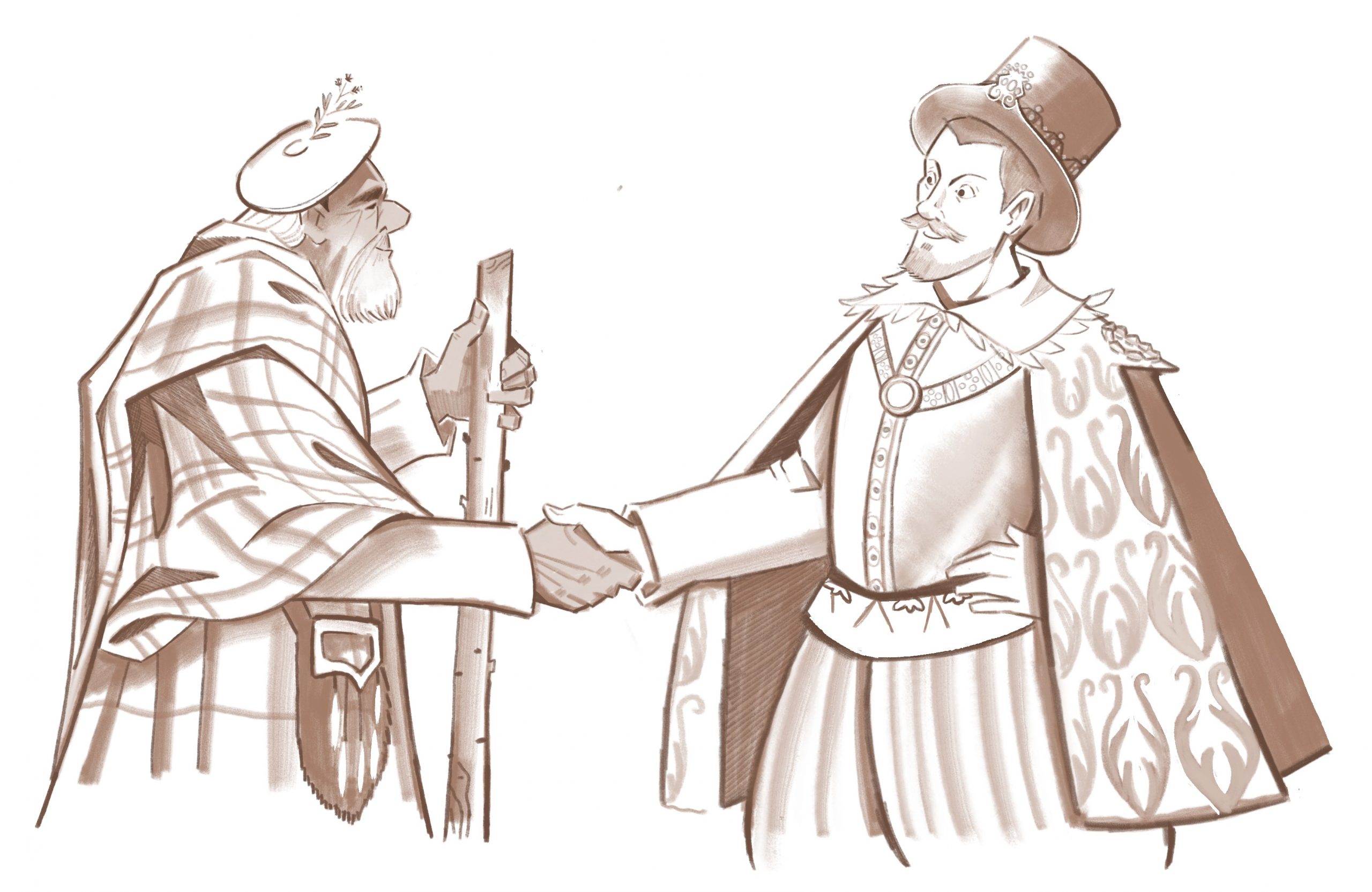
King James VI visits Kilravock, illustrated by Emilie Schieve
The hat story: Keep your hat on
When King James VI visited Kilravock Castle in 1589 he allowed Hugh Rose to keep his hat on in his presence and referred to him as “father”. The gesture was said to reflect the King’s deep personal respect for Kilravock’s reputation as a wise and highly esteemed figure. James had visited Kilravock as a child as well Kilravock had had good relations with his mother and grandmother.
Also on this visit, the King enquired how Kilravock could live among such "ill turbulent neighbours", referring to the Huntly-Moray feud. To which Hugh replied “they were the best neighbours he could have for they made him thrice a day go to God upon his knees when perhaps otherways he would not have gone one”. He was referring to Kilravock’s neighbouring clans such as the Gordons and Moray as mentioned above.
This post is part of the Kilravock Stories Exhibition, now on display at Nairn Museum until 25th September 2026. Explore the history of Clan Rose, Kilravock Castle, and the rich heritage of the Scottish Highlands.
References
A genealogical deduction of the family of Rose of Kilravock : Spalding Club (Aberdeen, Scotland) : Free Download, Borrow, and Streaming : Internet Archive
History of the Roses of Kilravock, First printed in commemoration of The Rose Clan Gathering held at Kilravock Castle on 20th June, 1970.