
Mary de Guise was a French noblewoman born into the powerful House of Guise in France. She first married Louis II d'Orléans, the Duke of Longueville in 1534, and had 2 sons with him, but both died young. After Louis’s death she married James V of Scotland in 1538, becoming Queen Consort of Scotland. Henry VIII had wanted her to be his 4th wife in an attempt to frustrate James and as part of his efforts to weaken Scotland’s alliance with France.
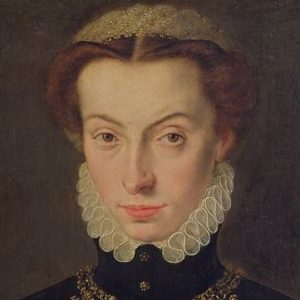
Image of Mary de Guise from https://www.kleio.org/site/assets/files/4259/marie_guise_ausschnitt.jpg
Mary de Guise gave birth to Mary on 8th December, and James V died on 14th December 1542 and so Mary, Queen of Scots inherited the throne. Initially, James Hamilton, Earl of Arran acted as her Regent, as he was next in line to the throne. Catholic Mary de Guise gradually took control of the government, officially becoming Regent of Scotland in 1554. During her regency, she worked to protect and advance the dynastic interests of her daughter. She tried to maintain Scotland’s alliance with Catholic France and resisted the growing influence of Protestant reformers inspired by figures like John Knox.
Her rule faced increasing opposition from Protestant nobles, leading to unrest and conflict in the early stages of the Scottish Reformation, led by the Lords of Congregation mentioned in one of her letters to Kilravock. English intervention on the Protestant side further weakened her position.
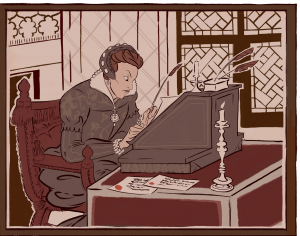
Mary de Guise writing letters, illustrated by Emilie Schieve
Mary de Guise died on 11th June 1560 in Edinburgh of natural causes, although there was speculation that she was poisoned by orders of Queen Elizabeth I of England. There was no evidence of these allegations. By August 1560, the Scottish Reformation saw the Parliament of Scotland adopt a Protestant Confession of Faith and nullify all authority of the Roman Catholic Church. Only two months after her death, Scotland formally adopted Protestantism, marking a major turning point in its religious and political history.
This post is part of the Kilravock Stories Exhibition, now on display at Nairn Museum until 25th September 2026. Explore the history of Clan Rose, Kilravock Castle, and the rich heritage of the Scottish Highlands.
References
https://www.kleio.org/site/assets/files/4259/marie_guise_ausschnitt.jpg
https://en.wikipedia.org/wiki/Mary_of_Guise