
The Battle of Pinkie Cleugh was fought on September 10, 1547, on the bank of the River Esk, near Musselburgh. It was the last major pitched battle between England and Scotland. Part of the "Rough Wooing," it was a catastrophic Scottish defeat where English combined arms tactics, infantry, cavalry, and naval bombardment decimated a larger Scottish army.
The Commanders of England were Edward Seymour, Duke of Somerset (approx. 16,000–19,000 men): for Scotland, James Hamilton, Earl of Arran (approx. 22,000–36,000 men). The Scottish casualties were estimated between 6,000 and 15,000 killed (known in Scotland as "Black Saturday"), while the English suffered only light losses, estimated between 200 and 600 killed.
Historical Context
The battle was the bloody climax of King Henry VIII’s campaign to force the Scots into a marriage alliance between the infant Mary, Queen of Scots, and his son, the future Edward VI. After Henry’s death, the Duke of Somerset marched an army north into Scotland to impose this union, believing it would also force the Scottish church to adopt the English Reformation.
Despite the massive military victory, the English failed to achieve their ultimate political goals. Rather than submitting to the English, the Scottish government smuggled the young Mary, Queen of Scots, to France, where she was betrothed to the French Dauphin, ultimately strengthening the Franco-Scottish "Auld Alliance".
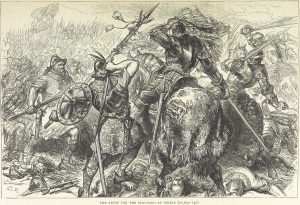
Image of Battle of Pinkie Cleugh, from https://upload.wikimedia.org/wikipedia/commons/thumb/4/42/The_fight_for_the_standard_at_Pinkie.jpg/1920px-The_fight_for_the_standard_at_Pinkie.jpg?_=20191031030808
Key Facts of Hugh Rose’s Capture & Ransom
Hugh’s ransom was set at 100 "angel" nobles (a significant sum of gold coins at the time). Because the English army demanded local financial security, prominent border-family figures, Pringle of Smailholm, Pringle of Torwoodlee, and Pringle of Wowhousebyre, stepped in as his "cautioners" (guarantors) to secure his eventual release.
The "Black Baron" went on to become one of the most diplomatically astute chiefs of Clan Rose. By surviving Pinkie Cleugh, he was able to guide his family safely through the chaotic Scottish Reformation. He maintained a rare, peaceful neutrality that earned him the personal friendship and visits of both Mary, Queen of Scots and her son, King James VI, at Kilravock.
This post is part of the Kilravock Stories Exhibition, now on display at Nairn Museum until 25th September 2026. Explore the history of Clan Rose, Kilravock Castle, and the rich heritage of the Scottish Highlands.
References
https://www.scotsmagazine.com/articles/east-lothian-battle-weekends-pinkie-cleugh/
https://en.wikipedia.org/wiki/Clan_Rose
https://fionamsinclair.co.uk/genealogy/highlandclans/Rose.htm
https://i0.wp.com/ddtours.co.uk/wp-content/uploads/2016/04/rough_wooing.jpg?fit=800%2C445&ssl=1&w=640