
The "Rough Wooing" was a series of brutal military conflicts launched by England's King Henry VIII against Scotland. The goal was to force the Scottish Parliament to agree to marry the infant Mary, Queen of Scots, to his son, the future Edward VI, and to try and break Scotland's historic alliance with France.
In July 1543, Scotland and England signed the Treaty of Greenwich, initially agreeing to the royal marriage. By December, the Scottish Parliament, influenced by pro-French and Catholic factions, changed its minds. Enraged by the rejection, Henry VIII ordered a series of destructive military campaigns. The 4th Earl of Huntly, George Gordon, famously described the English attempts to force a marriage between Mary and Edward by stating: "We liked not the manner of the wooing, and we could not stoop to being bullied into love.” The term “Rough Wooing” was later coined in the 19th century by Sir Walter Scott, who referenced how "rough" the diplomatic mode of wooing was at the time.
Although the war was centred in the lowlands and borders, Highland barons were forced to take sides. Some Highland and Island lords, notably the Clan Donald (MacDonalds of Islay), saw an opportunity to undermine the central Scottish Crown. They actively negotiated with the English, trading allegiance for English gold and naval support against their traditional rivals, the pro-Crown Clan Campbell. This fractured the Highlands along deep political and clan lines.
Other Highland barons were frequently called upon to contribute forces to fight the English in major pitched battles Many Lowland barons and the Scottish government were forced to retreat into the Highlands for safety. This brought the Highlands into the national spotlight, increasing the political leverage of Highland barons, whose rugged terrain and manpower were suddenly crucial to protecting the Scottish Crown and smuggling the young Queen Mary to France. English forces repeatedly raided the Scottish borders, burned Edinburgh, and occupied southern Scotland. The conflict saw massive pitched battles, most notably the devastating English victory at the Battle of Pinkie Cleugh in 1547. Our Kilravock took part in the Pinkie Cleugh battle and fought for the Scottish Government. Instead of submitting to England, the Scots turned to France for military aid. In 1548, they agreed to betroth Mary, Queen of Scots to the French Dauphin (later Francis II). Mary was subsequently sent to France for her safety and education. English forces eventually withdrew, and the devastating conflict officially ended with the Treaty of Norham in 1551.
The distraction of the English war left a power vacuum in the north. Many Highland barons took advantage of the Crown's preoccupation with England to settle old territorial scores, leading to a spike in internal Highland warfare. While some barons gained power and wealth by serving as mercenaries or English sympathisers, others were ruined by the resulting economic blockades and destruction of trade. Our Kilravock survived by carefully steering a neutral course through these turbulent times.
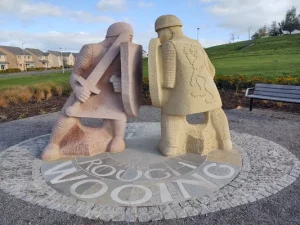
The Rough Wooing Monument in Musselburgh, unveiled in 2021.
This post is part of the Kilravock Stories Exhibition, now on display at Nairn Museum until 25th September 2026. Explore the history of Clan Rose, Kilravock Castle, and the rich heritage of the Scottish Highlands.
References
https://en.wikipedia.org/wiki/Rough_Wooing
https://www.kinnaird.net/scothist.htm
https://img.atlasobscura.com/