
Medieval Nairnshire
In the fourteenth century, the area now known as Nairnshire sat at a crossroads between lowland Scottish authority and the semi-independent Gaelic lordships of the north. The Church was a powerful landowner and political actor. Religious houses controlled extensive estates and appointed local priests to serve dependent chapels such as Kilravock. Written charters, which were legal documents sealed in the presence of witnesses, were essential for defining rights, responsibilities, and land use across this often contested landscape.
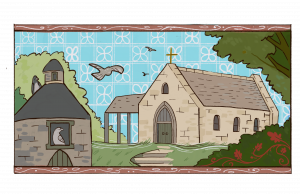
Image of Chapel by Emilie Schieve
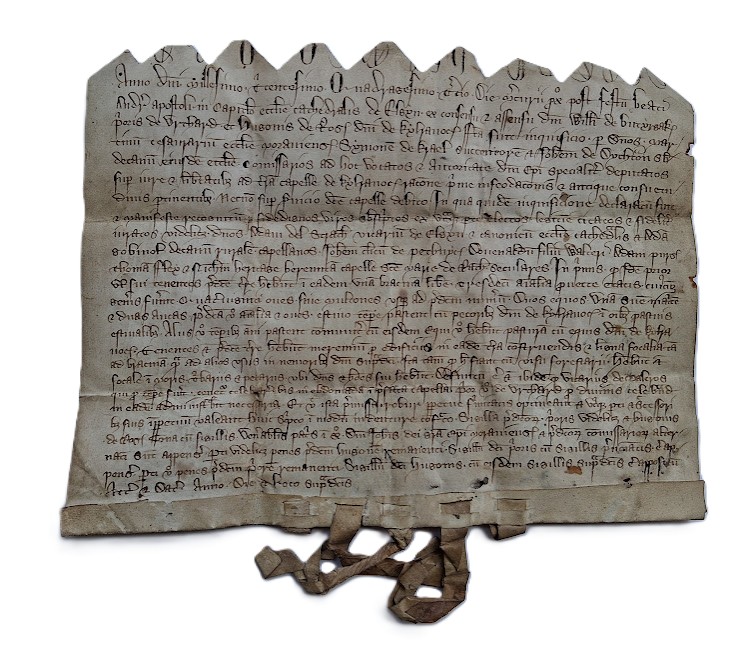
The Foundation Charter of Kilravock Chapel, 1343
This indenture document confirms the rights and customs of the Chapel of Kilravock and the lands attached to it. An indenture was a legal agreement written on a single sheet and then cut in half along a jagged line. The two halves could be matched back together like puzzle pieces to prove authenticity. Unfortunately, the other half of this indenture has been lost or destroyed. The word "indenture" comes from the "teeth" (indents) along the cut edge.
The charter of Kilvarock indenture was agreed by several notable figures, including Hugh Ross, Lord of Kilravock; Lord William Buttergask, prior of Urquhart (Moray); Lord Martin, treasurer of the church of Moray; and Nicholas Heritage, hermit of the chapel of Saint Mary of Rath (Rait).
The Hermit of Rait: Nicholas Heritage
Nicholas Heritage holds an intriguing role in this charter. In the late Middle Ages, hermits were not isolated recluses. Instead, they were often active members of local communities, maintaining infrastructure, offering spiritual guidance to travellers, caring for pilgrims, and serving as custodians of chapel buildings.
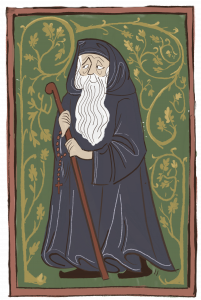
Image of Nicholas Heritage by Emilie Schieve
Land, Livestock, and Daily Life
The charter details medieval estate management. Livestock, including four-score (4 x 20 = 80) sheep, thirteen cows, two horses, one pig, and two geese, were permitted to graze with the lord of Kilravock's cattle, but only during the summer months. The chapel's land included a brewery, which required access to firewood. Tenants could take timber for building, but only with the consent of an unnamed forester. Fuel was gathered from moors, turf, and peat bogs, typical resources for communities across the Highlands. These terms, detailing tenancy rights and regulating livestock numbers, were common for church-owned lands in medieval Scotland.
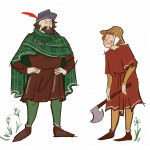
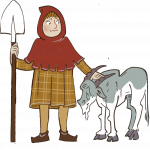
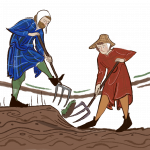
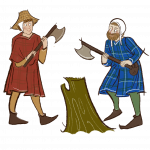
Illustrations by Emilie Schieve
Who Did What at the Chapel?
The charter also divides spiritual and practical responsibilities between two men. The vicar of Dalcros was bound (legally required) to celebrate Mass twice a week. However, the prior of Urquhart (Moray) was responsible for providing the 'necessary things' for worship: bread, wine, candles, vestments, and service books. In short, the prior paid; the vicar prayed.
This division reflects a common medieval arrangement. Religious houses like Urquhart Priory often controlled churches and collected their income (tithes). In return, they were expected to maintain the building and supply a vicar, a local priest paid a modest stipend, to serve the congregation. The twice-weekly celebration of Mass suggests that Kilravock Chapel was a dependent, relatively small, and possibly remote place of worship. It also indicates that the prior of Urquhart exercised significant religious authority across this part of medieval Nairnshire.
This post is part of the Kilravock Stories Exhibition, now on display at Nairn Museum until 25th September 2026. Explore the history of Clan Rose, Kilravock Castle, and the rich heritage of the Scottish Highlands.
References
Isla Baker researched and wrote the above piece.
For full transcription of this document see page 117-8 of A genealogical deduction of the family of Rose of Kilravock : Spalding Club (Aberdeen, Scotland) : Free Download, Borrow, and Streaming : Internet Archive