
By the late 14th Century Kilravock Castle was used as save place to keep important documents, most are land related but this one has an interesting story.
Euphemia, Countess of Ross (c.1350-1398) was the daughter of Uilleam III, Earl of Ross and became a key political figure in medieval Scotland. Her life was heavily shaped by royal control: in 1366, David II of Scotland forced her to marry Walter de Leslie to secure the Earldom of Ross. After Leslie’s death, she was compelled by Robert II of Scotland to marry Alexander Stewart, Earl of Buchan. Through this marriage, Stewart gained influence in the Highlands and strengthened his hold over extensive lands and titles, including those of Earl of Buchan and Lord of Badenoch.
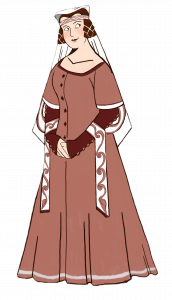
Euphemia, Countess of Ross, illustrated by Emilie Schieve
Alexander Stewart was the 2nd son of Robert II of Scotland and grandson of Robert the Bruce. He gained notoriety for violence and lawlessness and became known as the “Wolf of Badenoch”. Alexander took up with his mistress, Mariota de Athyn and abandoned Euphemia, which led to Euphemia asking for a divorce which threatened his hold over the lands of Ross. Supported by the Bishop of Moray, Euphemia pursued separation, leading to Stewart’s excommunication. Possibly in retaliation, Stewart launched a destructive campaign in the summer of 1390, burning Forres and much of Elgin, including its cathedral.
After the divorce Euphemia regained control of her lands and title. To protect her estates from Stewart, she temporarily transferred them to her brother, as mentioned in the charter below. She ensured her family’s legacy by passing the earldom to her son, Alexander Leslie, Earl of Ross. By her death around 1398, she had reasserted her authority and secured her family’s position in the Highlands. In contrast, the Wolf of Badenoch’s legacy is remembered for destruction and cruelty while Euphemia’s is one of survival, political manoeuvring, and ensuring her family’s future.
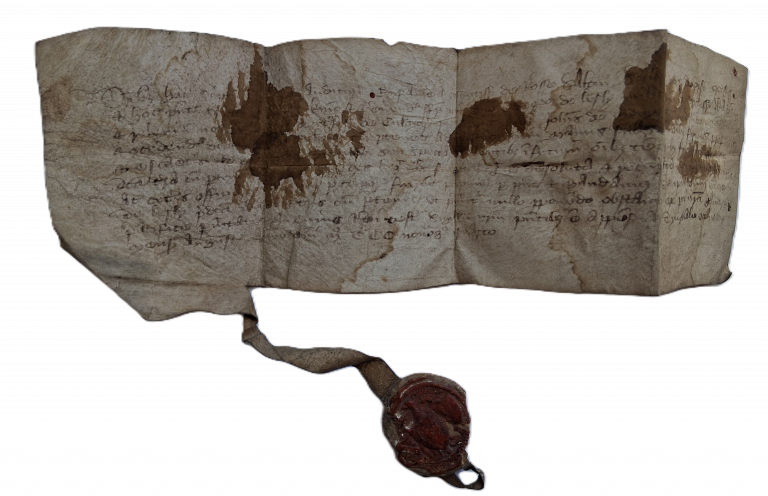
Euphemia's Charter and seal from 1394
The Charter’s summary
In 1394, Euphemia, Countess of Ross, granted her brother Sir George de Leslie the wardship and relief connected to the lands of Culmor (formerly belonging to John de Monymusk). She also gave him temporary possession of the lands and their revenues until the rightful heirs legally reclaimed them. Her officials were ordered to allow George to hold and benefit from the property peacefully. The document was issued at Dingwall.
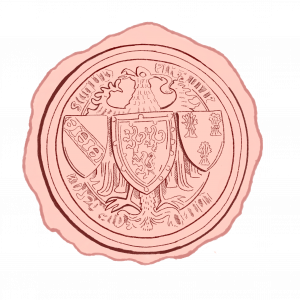
The seal illustrated here by Emilie Schieve.
The beautiful seal of the grantor, of which but an imperfect impression is attached to this charter. It gives her own shield of the earldom of Ross between the coats of Leslie and Buchan, which she displayed with her own as the arms of her successive husbands. In keeping with the custom of her family, the entire composition is suspended from an eagle's neck.
This post is part of the Kilravock Stories Exhibition, now on display at Nairn Museum until 25th September 2026. Explore the history of Clan Rose, Kilravock Castle, and the rich heritage of the Scottish Highlands.
References
For full transcription of this charter see page 138 of A genealogical deduction of the family of Rose of Kilravock : Spalding Club (Aberdeen, Scotland) : Free Download, Borrow, and Streaming : Internet Archive
https://en.wikipedia.org/wiki/Euphemia_I,_Countess_of_Ross
The history of the Province of Moray : comprising the counties of Elgin and Nairn, the greater part of the County of Inverness and a portion of the County of Banff, all called the Province of Moray before there was a division into counties : Shaw, Lachlan, 1692-1777 : Free Download, Borrow, and Streaming : Internet Archive