
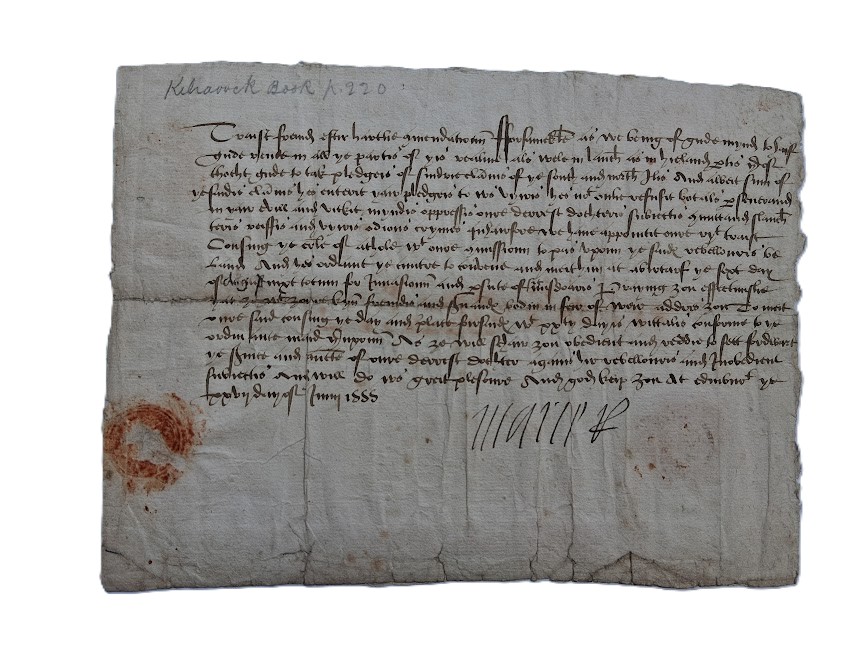
Summary of letter dated 27th June 1555:
Mary wishes to maintain order across Scotland, by requiring certain clans to pledge loyalty (hostages). While some comply, others continue committing violence, theft, and oppression. To suppress these rebels, she appoints the Earl of Atholl to lead a military campaign. Local regions are ordered to gather at Abertarff on August 6th to support him. This letter asks Kilravock and his followers to join this force, bringing twenty days of supplies, to show loyalty to royal authority.
Historical Context
In 1555, Mary de Guise was strengthening her control as Regent of Scotland, but her government faced growing resentment among Scottish nobles and clan leaders. Much of this opposition came from her increasing reliance on French advisers and officials, such as Henri Cleutin, Yves de Rubay, and Bartholomew de Villemore. Some Scottish nobles viewed this as foreign interference in Scottish affairs but many supported her in 1555.
During 1555, there was also persisting unrest in both the Borders and Highlands. Mary attempted to settle long-running feuds, including disputes between the Scott and Kerr clans. She sent Earls of Huntly and Argyll to deal with disorder in areas including Moidart, Lewis, and Sutherland. These campaigns achieved only limited success during this year.
In June 1555, a controversial parliamentary act abolished the office of Deacon of the Crafts. Originally, the Deacon’s primary duty was to inspect the work, materials, and workmanship of fellow tradesmen to ensure they matched the standards set by their Seal of Cause (charter). Throughout the 1500s, Deacons pushed for greater representation on town councils, which merchants previously dominated, gaining seats in some areas. Critics accused them of forming “bands” or alliances that could stir unrest. When Mary de Guise came to power, she abolished the positions of these Deacons. Instead councils would appoint “Visitors” officials whose role was limited to inspecting the quality of work, without the wider political authority or ability to organise craftsmen collectively. Craftsmen were also largely excluded from municipal office, except for a very small number approved by the council. The measure was widely seen as an attempt to curb the democratic influence of the crafts and strengthen merchant control of local government. It provoked particularly strong resistance in Perth, one of Scotland’s most politically active burghs, where craftsmen formed a large proportion of the population and tax base. Opposition became serious enough that Mary de Guise personally travelled to Perth to negotiate and calm tensions.
The backlash was so intense that the policy quickly became impractical. Within about a year, the regency effectively reversed course and restored many of the craftsmen’s traditional privileges, including the right to elect deacons again. The episode revealed how politically organised the urban crafts had become by the mid-sixteenth century and foreshadowed the broader constitutional and religious conflicts that would soon erupt during the Scottish Reformation.
Although dissatisfaction with her rule was growing in 1555 from all these factions, there was no major rebellion or battle against her authority. Instead, it was a period of political manoeuvring and consolidation of power.
The Meaning of “Hostage” in 1555
The term “hostage” mentioned in the original letter did not necessarily mean a captive in the modern sense. More commonly, it referred to a person given as a pledge or guarantee that an agreement, treaty, or promise would be honoured. Hostages served as guarantees of good faith between rulers, clans, or rival powers.
Summary
The letter sent to Kilravock reflects Mary’s wider effort to consolidate power in the Highlands by combining military force with demands for obedience from local landowners and clan leaders. It also shows how the Scottish government depended on regional nobles and their followers to maintain order in areas beyond direct royal control.
This post is part of the Kilravock Stories Exhibition, now on display at Nairn Museum until 25th September 2026. Explore the history of Clan Rose, Kilravock Castle, and the rich heritage of the Scottish Highlands.
References
For a full transcription of this letter see page 220 of A genealogical deduction of the family of Rose of Kilravock : Spalding Club (Aberdeen, Scotland) : Free Download, Borrow, and Streaming : Internet Archive
https://dangerouswomenproject.org/2017/03/07/mary-de-guise/
https://en.wikipedia.org/wiki/Mary_of_Guise
https://despardes.com/my-word-of-the-year-hostages/
https://electricscotland.com/history/glasgow/glasgow57.htm?utm_source=chatgpt.com