
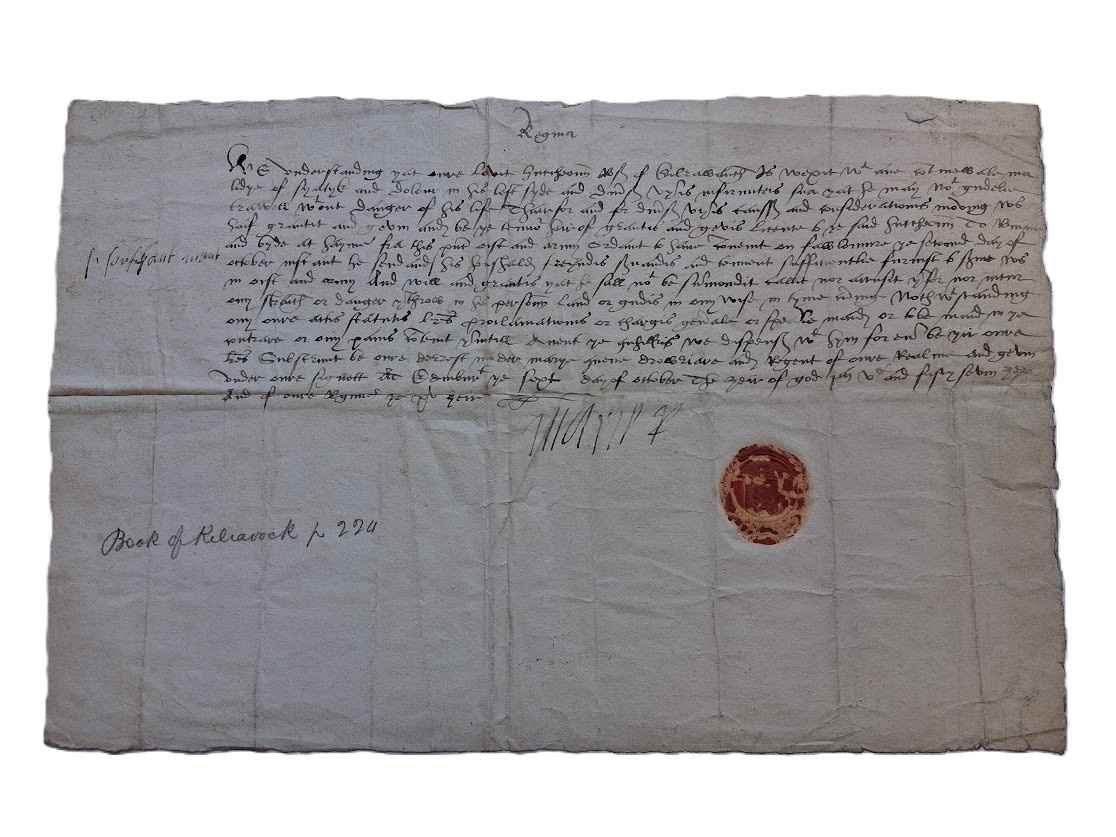
Summary of letter written 6th October 1557:
Mary de Guise excuses Kilravock from joining the royal army at Falkland in October 1557 due to sciatica. He is permitted to remain at home without penalty to himself or his property despite any existing laws to the contrary. He is still required to send his followers from his household, servants, and tenants properly equipped to serve in his place.
Historical Context
This document belongs to a tense period in mid 16th century Scottish history, when the regency government of Mary de Guise was attempting to defend Scotland’s alliance with France and maintain royal authority amid growing political and religious instability. Her government relied heavily on the long-standing “Auld Alliance” between Scotland and France against England. During the 1550s, relations between Scotland and England massively deteriorated, particularly after the marriage of Mary, Queen of Scots, to the French Dauphin was being negotiated. England feared becoming strategically encircled by a Franco-Scottish alliance.
In 1557, Scotland was drawn into war with England as France and England entered open conflict during the later stages of the Italian Wars. Under the terms of the Auld Alliance, Scotland was expected to support France militarily. Mary de Guise therefore ordered Scottish nobles and lairds to assemble their forces at Falkland in October 1557 in preparation for an invasion of northern England.
The muster at Falkland became politically controversial. Many Scottish nobles distrusted the regent’s French advisers and were reluctant to undertake what they viewed as a risky war serving French rather than Scottish interests. According to later chroniclers, several nobles refused to cross the border after gathering at Falkland, causing embarrassment to the regency government and revealing weakening support for Mary’s policies.
Within this setting, the exemption granted to Hugh Rose of Kilravock illustrates how military obligations functioned in 16th century Scotland. Landowners were expected to provide military service to the Crown when summoned. Even when personally excused because of illness, a laird still had to fulfil his feudal duty by sending armed followers drawn from his household, tenants, servants, and allies. The wording of the letter is also significant because it demonstrates the Crown’s legal authority. Mary explicitly guarantees that Rose will suffer no penalty to his “person, lands, nor goods” for failing to appear in person, despite any standing acts or proclamations requiring attendance. Such protections were important because failure to answer a royal summons could technically expose a nobleman to fines, forfeiture, or accusations of disloyalty.
The events surrounding the Falkland muster foreshadowed deeper crises ahead. Within two years, Scotland entered the upheaval of the Scottish Reformation. Opposition to French influence, resentment of royal centralisation, and distrust of the regency all contributed to the Protestant Lords of the Congregation rebellion against Mary de Guise’s government by 1560.
Sciatica
The document specifically mentions chronic ailments, sciatica and pain in his side, as sufficient grounds to excuse his personal attendance. Chronic pain disorders were taken seriously because travel in 16th century Scotland was physically demanding, long rides on horseback, rough roads, cold weather, and military campaigning could genuinely incapacitate sufferers.
This post is part of the Kilravock Stories Exhibition, now on display at Nairn Museum until 25th September 2026. Explore the history of Clan Rose, Kilravock Castle, and the rich heritage of the Scottish Highlands.
References
For a full transcription of this letter see page 224 of A genealogical deduction of the family of Rose of Kilravock : Spalding Club (Aberdeen, Scotland) : Free Download, Borrow, and Streaming : Internet Archive
https://en.wikipedia.org/wiki/Mary_of_Guise
Mary of Guise | Scottish Historical Figures | History of Scotland