
Viewfield House played host to a multitude of Allied Soldiers through the course of World War Two, playing its national duty in supporting the war effort.
Before it was used to house Allied Soldiers in 1941, Viewfield House was actually used as an emergency mortuary for Nairn. We have recently uncovered this previously unknown history of the building due to research by volunteers into local newspaper, the Nairnshire Telegraph.
The Nairnshire revealed that the building was deemed to be unsuitable for the storage of a semi-mobile kitchen allocated by the Ministry of Food. In 1941, Viewfield House stopped its service as an emergency mortuary and was instead turned into temporary barrack accommodation for soldiers of the reformed 51st Highland Division.
The 51st Highland Division was based at Fort George in Ardersier whilst preparing for the Allied Landings in Normandy in June 1944. Due to the large volume of soldiers stationed at the barracks, the facility couldn't hold the sheer number of troops and so were commonly barracked with local families and institutions. Nairn beach was used as a training site to practice amphibious landings both day and night.
The soldiers were trained to complete a successful landing assault, as well as driving military vehicles off landing craft directly onto the beach under realistic combat conditions. In recent years, the shifting sands of Nairn beach have revealed unexploded ordnance such as mortar bombs or pieces of military vehicle equipment left by the soldiers training procedures. The movements of the soldiers on the beaches was also part of a national effort to promote disinformation to German intelligence on potential Allied invasion sites. We constantly marvel at nature’s power to reveal the history of our past and the sacrifice of those men who trained on our now peaceful beaches.
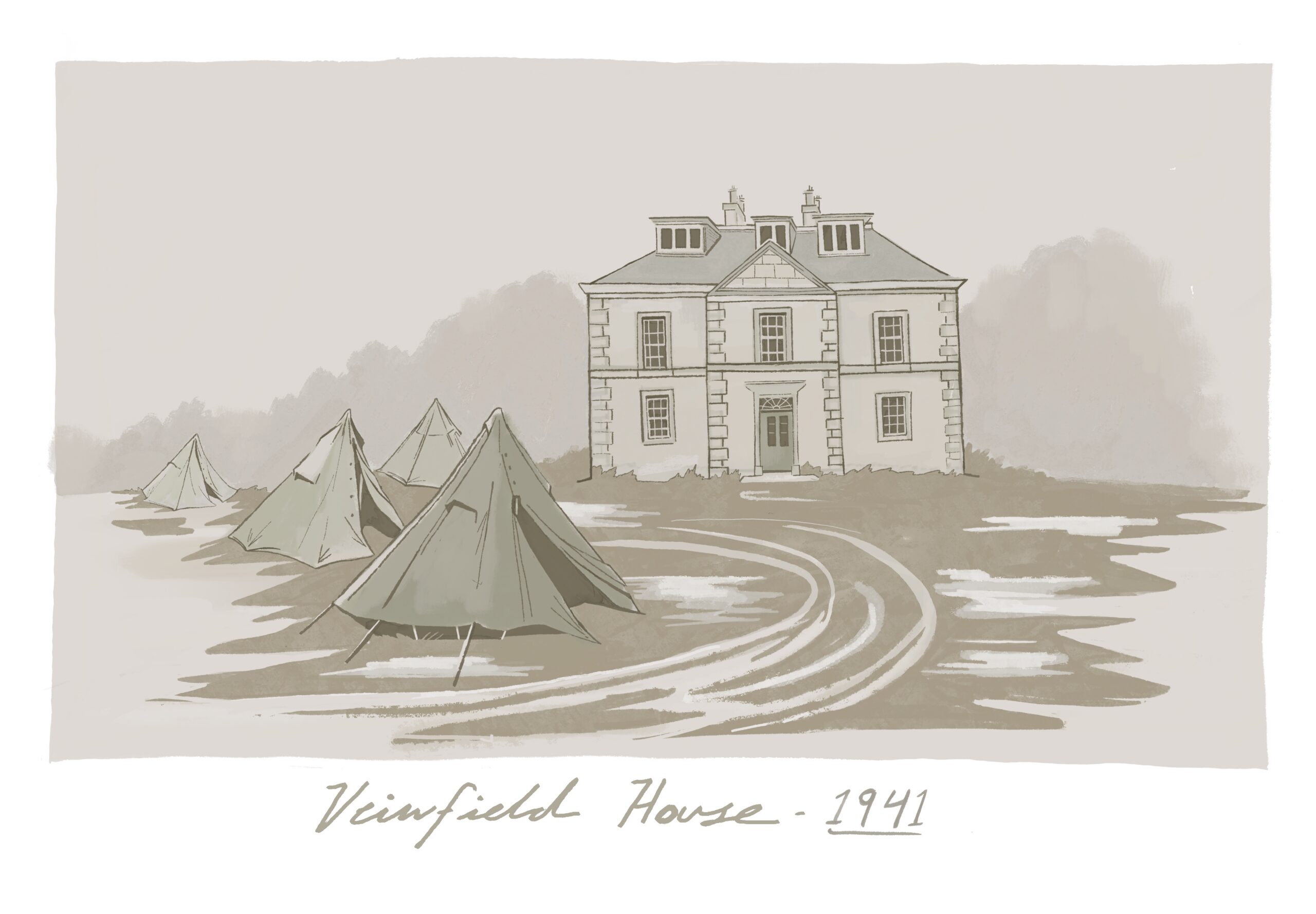
Illustration of Viewfield House by artist Emilie Schieve
After the Allied Invasion of Normany in June 1944, Viewfield House remained empty for a couple of months until it was again utilised to house Allied Polish soldiers. Polish soldiers were evacuated to Britain after the joint 1939 German-Soviet invasion of Poland and the subsequent fall of France in June 1940. Around 17,000 Polish soldiers were evacuated to Britain, gradually increasing to about 26,500 in 1944 as troops were released from Soviet captivity and additional recruits from the Polish diaspora. The Polish soldiers were reformed in Britain into the 1st Polish Army Corp, the majority of which were deployed to Scotland.
The 1st Polish Army Corp was tasked with the defence of Scotland’s East Coast. The Polish troops helped to build, maintain and extend coastal defences alongside anti-tank barriers and pillboxes. The British government wanted to ensure that Scotland’s east coast was well defended against a potential German invasion from occupied Norway. So throughout 1945, Polish soldiers were stationed in Viewfield House tasked with manning Nairnshire’s coastal defences. The Polish soldiers integrated well within Nairnshire’s community, holding public concerts with Polish music and supporting the community’s farmers at harvest time.
Viewfield House was the homestay for many Allied soldiers over the course of World War Two, its walls still hold the memories of their experiences. The sacrifices of the soldiers in their military service and the separation from the families far from home, will never be forgotten.
Lest we forget, and we won’t. With love to you all.
Lucy Dickson, Collections Assistant on behalf of Nairn Museum
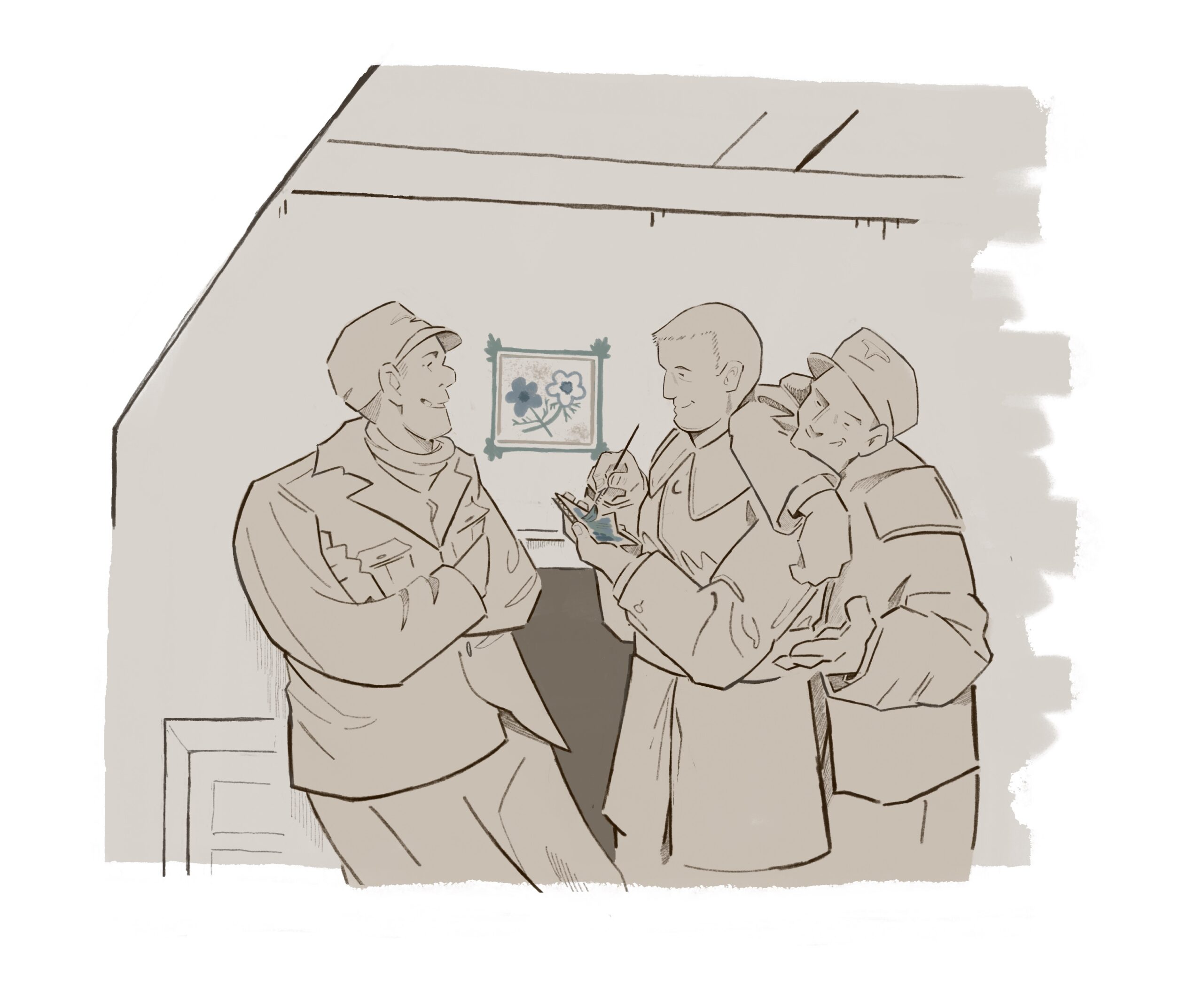
An illustration of Polish Soldiers painting on the attic wall of Viewfield House by artist Emilie Schieve.